Lost Michelangelo Study for Sistine Chapel to be Auctioned for Up to $2 Million
When Giada Damen, an expert in Christie’s Old Master drawings department, received an unsolicited photograph via the auction house’s “Request an Auction Estimate” online service, she could never have imagined what had just rolled into her inbox.
The curious but unsuspecting owner had just submitted a major discovery: a previously unknown study by Michelangelo for his world-famous frescoes in the Sistine Chapel. Damen identified the work in red chalk as a preparation for the right foot of the monumental figure of the “Libyan Sibyl,” which is located at the far east end of the Sistine ceiling. According to Christie’s, Michelangelo created the study around 1511–12 just before he embarked on the second half of the massive mural.
Now the newly identified work, which is the first unrecorded study for the Sistine Chapel, is also the first to ever come to auction. It’s slated to hit the auction block on February 5, 2026, with an estimate of $1.5 million to $2 million.
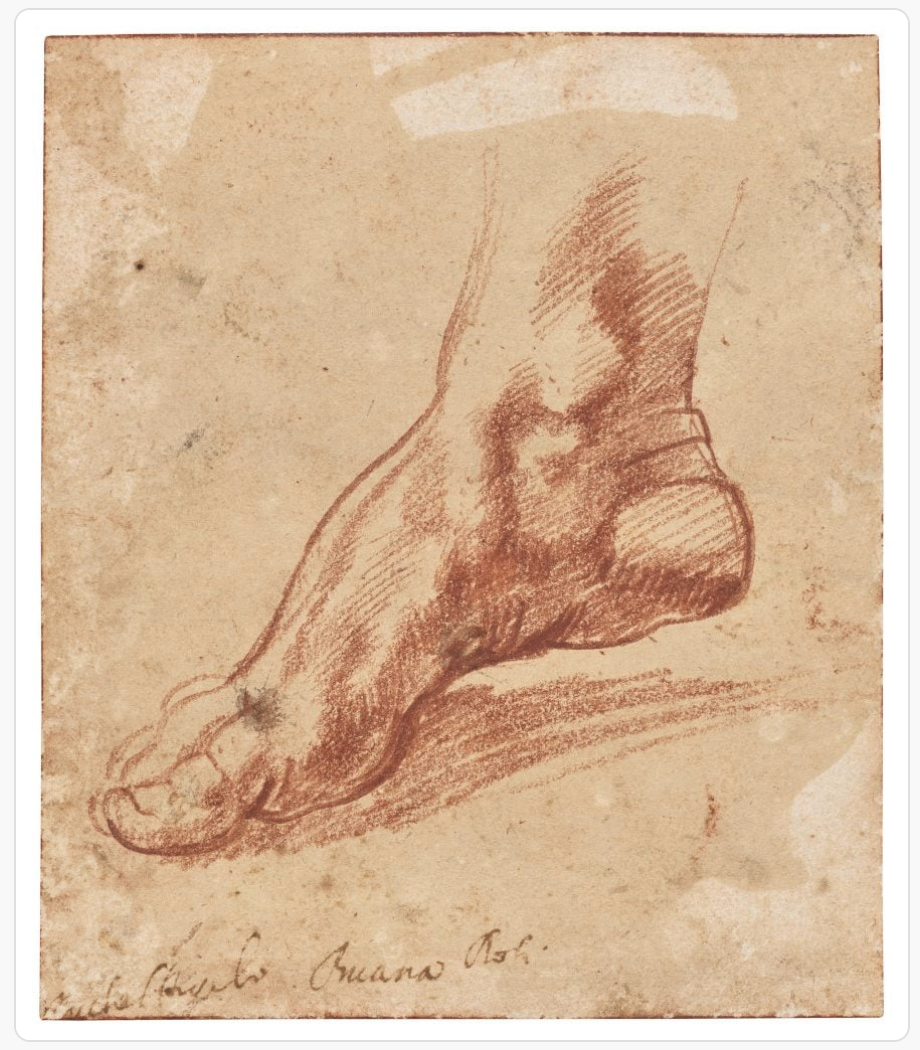
According to Damen, it’s one of only about 10 Michelangelo drawings known to be in private hands. There is no accounting for the number of drawings the Old Master created, but only about 600 are believed to have survived, of which some 50 are related to his work on the Sistine Chapel.
The drawing was submitted by a gentleman on the West Coast, who wishes to remain anonymous. He inherited the drawing as part of a group of objects from his grandmother. He had been familiar with the drawing his entire life, as well as the fact that it had been passed down through his family in Europe since the late 1700s, but he didn’t know who the artist was.
For her part, Damen immediately recognized the work as being of “significant quality,” though she said she was careful not to jump to conclusions. However, she did immediately drop everything and get on a plane to see the work in person.
After securing the approval of the owner, the work was brought back to New York to undergo research. This included infrared reflectography, which revealed drawings on the back of the sheet that are not viewable to the naked eye. However, they too look like the work of a 16th-century artist close to Michelangelo, according to Christie’s.
Damen realized that the original drawing is similar in medium, style, and subject to a famous Michelangelo drawing at the Metropolitan Museum of Art, as well as a copy of the Met sheet in the Uffizi, in Florence. The Uffizi copy shows the same studies as the Met but for one addition, the same foot as appears in the Christie’s drawing.
After six months of study, Damen brought the drawing to the Met and set it next to its Michelangelo. “That was the final piece of the puzzle,” according to a statement from Christie’s. What she had was an original Michelangelo drawing for the Sistine ceiling. “I was so excited,” Damen said in a statement. “It was clear that the two studies were by the same hand, done in the same moment.”
The auction house said that the ownership history of the drawing “also links it to Michelangelo,” and it has a “distinctive” inscription in brown ink in a 16th-century hand that reads: “Michelangelo Bona Roti.” The same signing appears on a number of Michelangelo drawings including the Met’s.
During the 18th century, the drawing went into the collection of Armand Louis de Mestral de Saint-Saphorin, a Swiss diplomat who worked for the King of Denmark. The drawing was passed down by successive generations of family to the present owner. Damen called the discovery “a once in a lifetime opportunity for me.”
The drawing will be on view at Christie’s in Rockefeller Centre prior to the February sale and at Christie’s London offices on King Street, November 27–December 2.